Your Council

Environment Fund

What is the Environment Fund?

Funding assistance for projects that protect and enhance Northland’s natural environment.

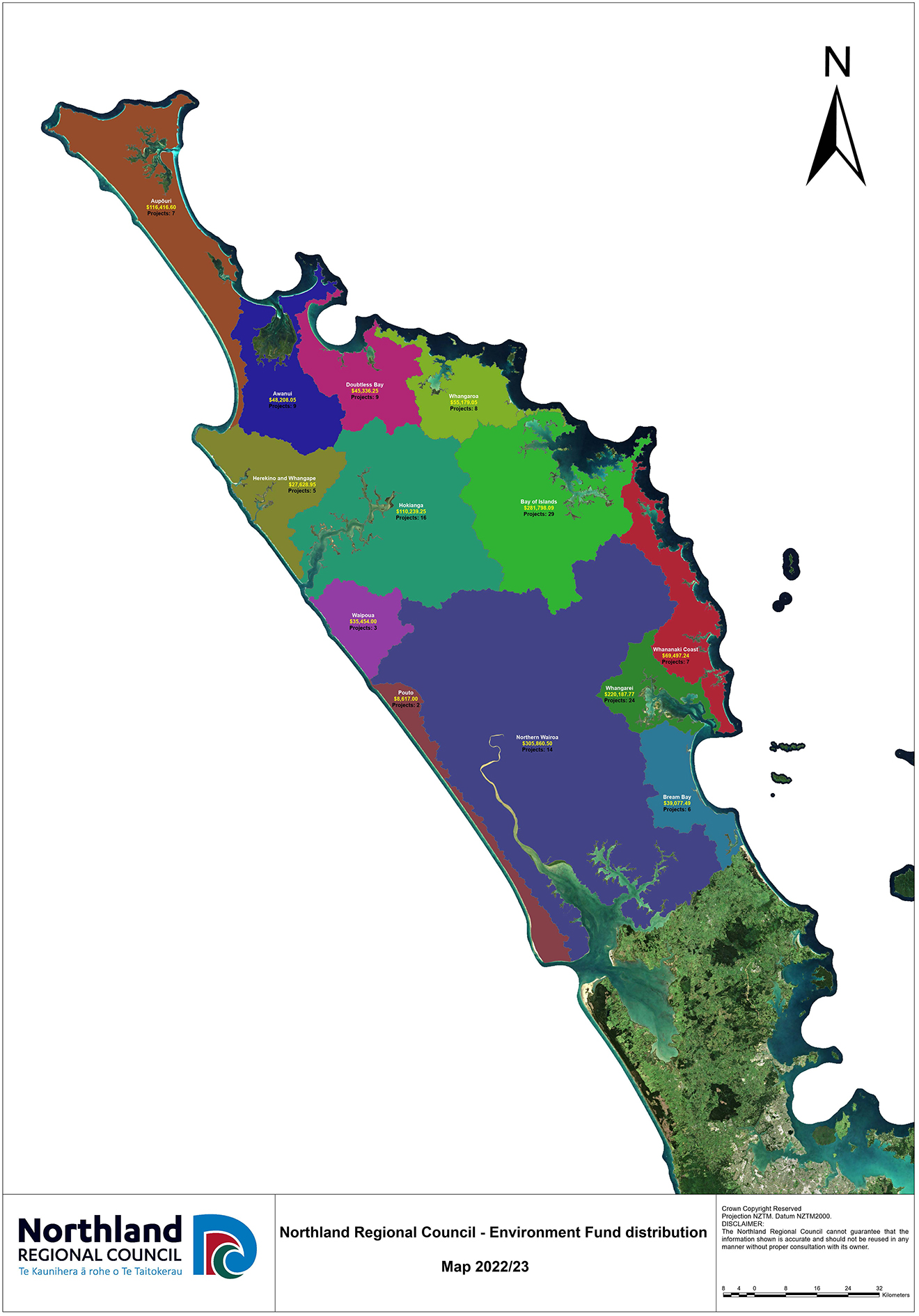
The Northland Regional Council Environment Fund has provided around $4 million to help people enhance and protect Northland’s natural environment since 1996.

Like last year, the contestable Fund is about $500,000.  The Regional Council recognises the effort and commitment that Northlanders are putting into addressing their environmental issues and the continuation of funding reflects this.  The fund is provided through five different funding streams with projects funded at up to 50% of their total costs.

One hundred and sixteen applications were made to the Environment Fund last year and typically more funds are requested than are available.

Environment Fund priorities

The Environment Fund has been set up to align funding with Regional Council Land Management priorities.

The new funding year begins 2 July 2012 and ends 30 April 2013.

To be eligible for consideration, projects will need to align with one or more of the following funding streams and will require landowner's consent to complete a Farm Water Quality Improvement Plan (FWQIP) for the property.

Priority funding streams

Slipping Te Hana.

Soil conservation – Targeting the maintenance and control of erodible soils, e.g. erodible land soil stabilisation via tree planting, fencing to exclude stock, pest control and other suitable means.


Taikirau wetland at Motatau.Biodiversity – targeting the restoration and protection of wetlands and lakes, e.g. fencing to keep out stock, riparian planting, pest control. 


Hihi Dune Planting Weekend.Coastal – targeting the restoration, protection and maintenance of estuaries, dunes and salt marsh, e.g. the planting of spinifex and pingao for dune stabilisation, pest control, fencing to exclude stock and riparian planting.


Cows beside stream.Water quality – targeting dairying and clean stream accord targets, dry stock exclusion from waterways and similar projects within recreational bathing site catchments*, e.g. fencing to exclude stock from waterways, riparian enhancement.


Exceptional projects – Regionally significant projects not available for funding under the other funding streams. These projects need to have high regional priority and be approved by the council.

*Northland Regional Council carries out monitoring of the region’s coastal environment to record the state of this resource, the effects of human activity and changes over time. 

Who can apply?

Funding can be allocated to individuals and voluntary groups for eligible projects; this may include landowners, community and conservation groups, local Māori groups and schools.

Projects must be of long-term benefit to the local environment and show evidence of good resource management.

Projects designed for personal or commercial profit, required under resource consent or simply to beautify a site, are not eligible for funding.

Projects must be consistent with the funding streams and associated targets to qualify for consideration of funding.

NOTE: the Environment Fund can contribute up to 50% of the total project cost.  The landowner must be able to provide the remainder of the cost through funding of their own, their time, other funding sources, or in-kind contributions such as voluntary labour and donated materials.

Funding is not retrospective – the regional council will not pay for work done before funding is approved.

When can I apply?

Projects not in the exceptional projects funding stream will be accepted from the start of July 2012 to the end of April 2013.

Projects that are in the exceptional projects funding stream will be limited to a four month application period, from the start of July 2012 to the end of October 2012.

How do I get funding?

It is a requirement that you contact Land Management Staff at the regional council; this discussion will help clarify eligibility for funding and what the process requires.

The Land Management Staff available to assist you with your funding enquiry are listed at the end of the guide.

Project approval process

This is a four stage process:

1.  Projects have their eligibility assessed via:

  • Information gained once a site inspection has been completed;
  • The submitted Farm Water Quality Improvement Plan and Agreement detail; and
  • Ranking each project against the funding stream targets and regional priority status.

2.  Projects under $20,000 and not entered through the exceptional projects funding stream are approved via delegated authority and reported to the council..

3.  Projects requesting over $20,000 or seeking funding through the Exceptional Projects funding stream are presented to the Environmental Management Committee for council approval, after which landowners are notified of the decision.

4.  Funding is approved once the Funding Agreement has been signed and dated by both parties.

Funding is not retrospective – the regional council will not pay for work done before funding is approved.

Projects without a signed agreement have not had their funding approved.

Funding decisions made by the Northland Regional Council are final with no rights of appeal or review.

Guidelines

View online
You can view or download a copy of the 2012-13 guidelines by clicking on the link below:

PDF logo.Download the 2012-13 Environment Fund Guidelines (628 KB)


Visit regional offices
You can collect a copy of the guidelines at our regional council offices. 

Find a map and directions for our offices in Whāngārei, Dargaville, Kaitāia and Ōpua

Request printed copy
You can request a printed copy of the guidelines to be sent to you by contacting the Northland Regional Council on freephone 0800 002 004 or email mailroom@nrc.govt.nz 

Help is available

If you require any further information, please do not hesitate to contact the Land Management team at the Northland Regional Council in Whāngārei, Dargaville or Kaitāia. The team is able to help you assess your project's eligibility and is available to discuss the project with you on site.

Whāngārei Head Office
Phone: (09) 470 1200 (freephone 0800 002 004)

Bob Cathcart (soil conservation) 

  • Soil conservation
  • Whāngārei Harbour priority catchment
  • General enquiries

Bruce Griffin

  • General enquiries/biodiversity
  • Community groups

Dean Evans

  • General enquiries 

Debbie Johnson (water quality)

  • Water quality monitoring sites (recreational bathing sites)
  • Fencing to exclude stock from waterways, riparian planting
  • General enquiries.

Laura Shaft (coastal)

  • Sand dune protection and restoration
  • Other coastal projects.

Lisa Forester (biodiversity)

  • Wetlands
  • Lakes
  • Wetland and lake enhancement and protection via fencing to keep out stock, riparian planting and pest control
  • General enquiries.

Wayne Teal (Poplar and willow supply)

  • Erodible land
  • Soil stabilisation via tree planting
  • General enquiries.

Sue Hicks (administration)

  • All Environment Fund project administration.

Rod McGregor

  • Mangere priority catchment
  • General enquiries

Kerry Webster

  • Mangere priority catchment
  • General enquiries

Duncan Kervell

  • Waitangi priority catchment
  • General enquiries

Lorna Douglas

  • Whāngārei Harbour priority catchment
  • General enquiries

Kaitāia Regional Office
Phone: (09) 408 6600

Doug Foster

  • General enquiries

Peter Wiessing

  • General enquiries

Anita Semenoff

  • Waitangi priority catchment
  • General enquiries
Dargaville Regional Office
Phone: (09) 439 3300