For Schools

Oil Pollution

What is oil pollution?

 
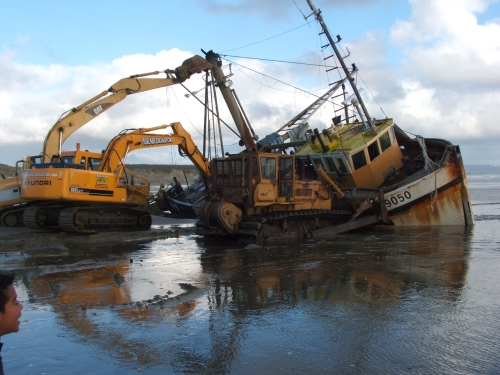
Northland’s coastline can be hazardous for shipping. Above, a fishing boat has run aground on the west coast. 
The sea is used by people in many different ways – for enjoyment such as swimming and surfing, as a source of food such as shellfish and fish and as a way to carry many types of goods in ships which travel around the coastline and overseas. All of these uses are valuable to New Zealanders and the New Zealand economy, but they place a demand on the marine environment. Preserving our beautiful marine environment is important to everyone and all of the organisms living in the ocean and around the coast. New Zealand has strict rules to prevent pollution and mostly these are adhered to, but accidents can and do occur.

Petroleum oil is formed over millions of years deep under the ground from the remnants of forests and from a mixture of comparatively volatile liquid hydrocarbons (compounds composed mainly of hydrogen and carbon with some nitrogen, sulphur, and oxygen) that occurs in the Earth's crust. While it is a naturally occurring substance, it can be highly toxic and burns fiercely. It is used as fuel to run many types of engines for cars, planes, ships, tractors and trucks. Petrochemicals derived from petroleum are the base for solvents, paints, plastics, synthetic rubber and fibres, soaps and cleansing agents, waxes and jellies, explosives, and fertilisers. Petroleum fuels also generate a large portion of the world's electrical-power supply. Asphalt from petroleum is used to surface roads and highways. Petroleum is also used as a lubricant in a great variety of machines.

Oil is petroleum in any form including crude oil, fuel oil, sludge or refined products such as diesel.

New Zealand is not a big producer of oil, which is why most of the oil is imported.
Oil pollution is a real risk in Northland because the country’s only oil refinery is at Marsden Pt on the east coast near Whangarei. Ships carry oil to the refinery in crude form from overseas and from oil wells around New Zealand. This crude oil is refined or transformed at the refinery into the different types of fuel that are needed to run our cars, trucks, planes and trains.

Once the fuels have been made, they are picked up by ship and taken all over New Zealand to other ports where it is distributed to fuel companies.
Some points to note:

  • Northland is New Zealand’s most at-risk region
  • 25% of all New Zealand’s reported oil spills occur in Northland
  • We have $2.1 million worth of equipment for use in case of an oil spill


Northland Regional Council’s role and policy


There are different degrees of seriousness of oil spills, and these are classed as Tier 1, 2 or 3.

Under the Maritime Transport Act, regional councils are responsible for responding to marine oil spills which would cost up to $250,000 to contain and clean up. This is classed as a Tier 2 response. Any spill which requires a response that will cost more than this becomes a Tier 3 response and would require national and even international help.

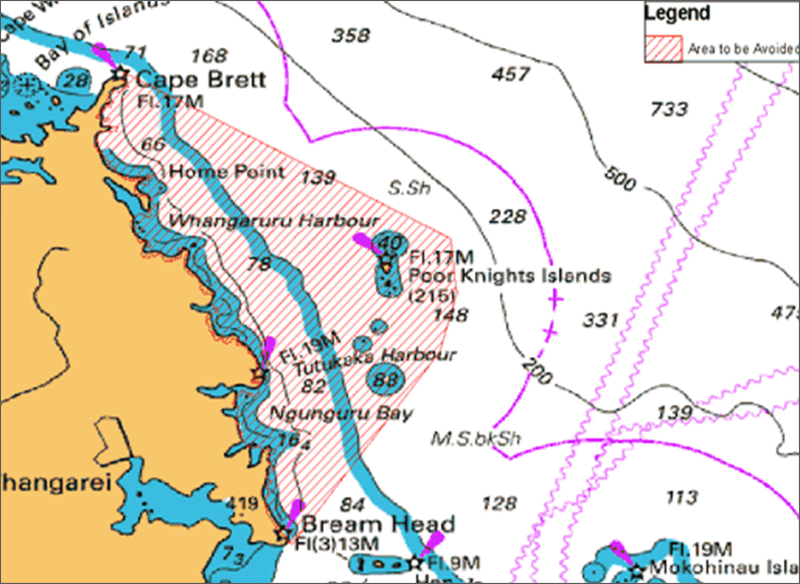
The Northland Regional Council is responsible for the marine area extending 12 miles out to sea from the Northland coastline. The border is between the Kaipara Harbour entrance to just south of Mangawhai Heads and includes the offshore islands of the Hen and Chickens and Poor Knights Islands. It does not include the Moko Hinau Islands or the Three Kings Islands which come under the control of the Department of Conservation.

The council has developed the Northland Regional Tier 2 Plan which aims to:

  • Evaluate a report on an oil spill within one hour of the report being received
  • Alert interested parties within two hours of the spill being reported
  • Mobilise appropriate people and equipment within three hours of the spill being reported.

The council has a programme for training all of its maritime staff and some other staff to deal with oil spills. These staff members have to know exactly what to do and act quickly to respond to an oil spill. They have to be familiar with the equipment needed to deal with a spill. Exercises are held three or four times a year, sometimes with no notice to make sure staff members are ready.


What is the risk?


The major port for Northland is the Port of Whangarei. This port includes Marsden Pt, the site of New Zealand’s only oil refinery, and Port Whangarei. The jetties at Marsden Pt are designed to handle large crude oil carriers while Port Whangarei handles general cargo vessels.


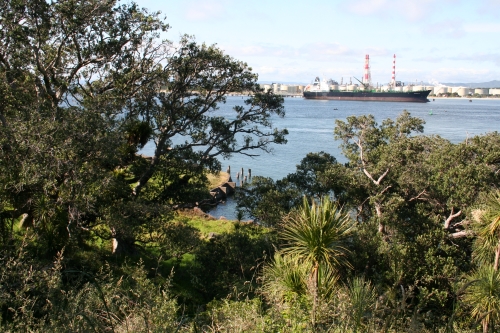
Marsden Pt is New Zealand’s only oil refinery, turning crude oil into a range of fuels.

Most significant spills that have occurred in the Northland region have been centred around the oil industry at Marsden Pt. Accidents have occurred during ballasting of oil tankers, loading and discharging of oil or the internal transfer of oil within a ship. These spills rarely exceed five tonnes.

The New Zealand Refining Company at Marsden Pt takes the risk of spills very seriously and has many prevention measures in place, as well as holding regular emergency exercises.

Spills that occur in other Northland harbours are mostly small, involving petrol or diesel, and happen during refuelling of pleasure boats and fishing boats.

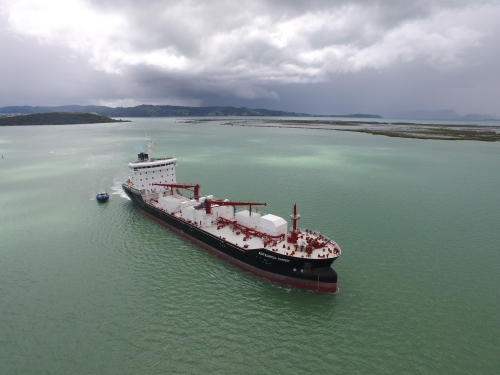
However, international shipping is another major factor for Northland, with the potential for a large oil spill. Ships regularly travel along the entire coast of Northland to pick up and deliver loads such as oil, kiwifruit, logs, fertiliser and cement. As they travel along the coast and head into ports they travel through important fisheries and near marine reserves.

In 1997 about two million tonnes of crude oil was delivered to the refinery and about 1.17 million tonnes of refined product was sent out over the wharves. Some of the large tankers can carry about 100,000 tonnes of crude oil. Some of the crude oils come from countries in the Persian Gulf and some are from New Zealand crude oils from Taranaki.

Northland has a varied coastline, including rocky points and sandy bays, estuaries and river mouths.

While an oil spill on sandy beaches and exposed rocky shores would be unsightly, these would recover reasonably quickly because the natural forces of wind and water would help break down the oil residue and clean up operations are easier. The most sensitive parts of the coast in the event of an oil slick are our estuaries in harbours – and these are where ports are mostly commonly built because they are sheltered. The vegetation growing in estuaries, such as mangroves, eelgrass and saltmarshes are highly sensitive to oil pollution and do not recover well.

This vegetation plays an important part in the environment by oxygenating estuary waters, trapping sediment and offering a safe shelter for many varieties of fish to breed.

Estuaries are usually dense with vegetation and any clean-up operation would be extremely difficult if an oil slick floated in to coat the mangroves and their breathing roots.

The Poor Knights Islands marine reserve, off the east coast from Tutukaka, is another area that is highly sensitive to oil pollution. While it is characterised by rocky shores which would recover reasonably quickly from an oil spill, the organisms living in and around the islands are special and internationally important, and are particularly vulnerable to oil pollution.


What are the rules?


The Marine Pollution Regulations 1998 have made it illegal to dispose of any materials and substances from ships and boats into the sea. The marine pollution regulations were developed under the Resource Management Act and aim to prevent pollution. The Northland Regional Council is responsible for administering and enforcing these regulations in the Northland region out to the 12 nautical mile limit.

Beyond this limit, Maritime New Zealand is responsible for administering and enforcing the Marine Protection Rules which were developed under the Maritime Transport Act.

These rules aim to stop oil being discharged. Large ships must have oil filtering equiqment and sludge tanks to hold any spills. They are also asked not to carry ballast water in oil fuel tanks. Ballast water helps ships keep steady in the water.


Previous incidents


Salt water is sprayed on at low pressure to dislodge oil from the walls of a cave at the Poor Knights Islands.

In March 1999 a large oil spill occurred off the Northland coast near Tutukaka. This reached the Poor Knights Islands Marine Reserve. The spill was bilge oil from a ship, and was spread over a wide area. Patches floated among the islands and clumps of black oil were found coating rocks. Once the council was alerted, a plane and a boat were chartered to investigate. The Council found there were limited options for cleaning up this spill. The waters around the islands were too deep to be able to anchor booms to contain the oil. Dispersants were also unable to be used because they would make the oil sink to the bottom of the sea – an unwanted outcome in one of New Zealand’s premier scuba diving areas.

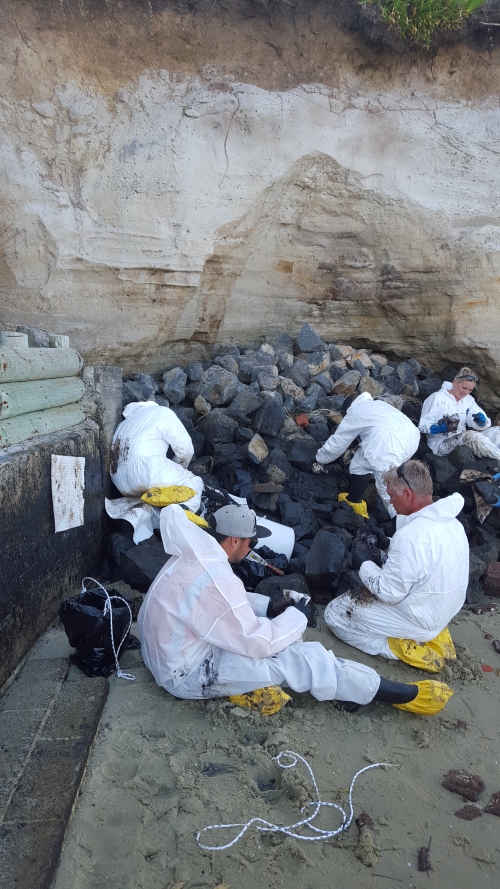
Instead the oil spill response team had to scoop up what they could manually and use low pressure spraying of salt water to dislodge oil from rocks. The rest was mopped up by hand using sorbent cloths. The prevailing wind moved the slick away from the islands and the Northland coastline, averting a greater mess.

In another incident about 10 years ago the engine room of the fishing boat Austral Achiever caught fire off the Poor Knights Islands and the vessel drifted out of control about 28km off the Northland coast. Weather conditions at the time were good and rescue services were able to control the vessel. However, there was still a small oil spill. If there had been a storm at the time, there was the potential for a major maritime disaster.

There have been two national or Tier 3 responses in New Zealand in recent years, which were luckily not in Northland. However, Northland Regional Council’s Harbourmaster was on-scene commander at both of these because he worked for Maritime New Zealand at the time. One was the Dong Won 529 in 1998. The Korean fishing boat foundered on rocks at Stewart Island. All the crew escaped safely but about 400 tonnes of oil was spilled. The other was in the Chatham Islands when another fishing boat was grounded and spilled fuel oil. The awkward sites and difficulties involved in dealing with the spills meant they quickly became classified as the most serious kind of oil spill, a Tier 3 response.


Types of oil pollution


Spilled oil spreads quickly and its movement will be determined by the tides and current as well as wind speed and direction. Oil will move at the same speed as the water carrying it and about 3% of wind speed. Crude oils are complex and variable mixtures of hydrocarbons of different molecular weight and structure. Crude oil may contain as many as 300 different compounds.

Types of oil commonly transported or used in Northland and the likely time to dissipate naturally are:

Oil Types  Time to dissipate naturally
Petrol A few hours to 1 day
Aviation gasoline A few hours to 1 day
Jet fuel/kerosene Up to 1 day
Light marine diesel 1-2 days
Light fuel oil    1-4 days
Medium fuel oil 1-7 days
Heavy fuel oil 1-2 weeks
Bitumen and crude oils Months but will probably sink out of sight if not cleaned up
 
There is a great deal of difference in crude oils depending on where in the world they come from. A crude oil database has been compiled from oil companies around the world showing the different physical and chemical properties of their products. This information helps emergency managers know what they are dealing with if there is an oil spill. The different mixtures affect how the oil behaves on water and the ways it can be cleaned up.

Oil whipped up with water forms a chocolate mousse effect as shown above at the Poor Knights Islands. This is extremely difficult to clean up

Some oils will evaporate or disperse naturally within hours while others will persist in the environment for much longer. Until the oil is dispersed, it will move according to the wind, wave, tide and currents.

Some of the lighter grades of fuels (such as diesel) have vapours that are toxic and are also potentially flammable. Petrol, kerosene and diesel will spread quickly over the surface of the water and usually evaporate quickly.
The safety of people is the first concern, above all else, during an oil spill. Sometimes it will be necessary to spread firefighting foam on the surface of a spill if it is close to something that could cause it to ignite.

Heavier fuels, most likely to be encountered at Marsden Pt or the Port Whangarei area, will not evaporate so easily. These types of oils will have to be treated with dispersants or collected in booms and skimmed into containers. Sometimes choppy water and whip an oil spill into what looks like a frothy chocolate mousse which is very difficult to dispose of because it floats so easily and forms large masses.

Even tiny amounts of oil – less than one part per billion – has been found to be sufficient to kill marine life. Swilling out a tank of diesel fuel or an outboard engine can have deadly consequences. Even rain falling on car parks will flush oil that has leaked from engines and carry it into drains and then into streams and bays. Marine life will be killed off even if only tiny traces of oil are present. Other consequences of oil pollution include deformities among surviving marine life.

When oils are spilled, they are subject to weathering and the prevailing environmental conditions. This will affect how long they remain a problem.


Emergency response


A marine oil pollution incident may occur at any time. A small spill may only involve a few people to deal with it, while a bigger incident may require many people from different agencies to help.

The Northland region has a Northland Marine Oil Spill Contingency Plan which provides a guide for all the people who may find themselves having to combat a spill.

A major incident may require upgrading to the National Marine Oil Spill Contingency Plan, which would tap into national and even international resources.

The scale of an oil spill will determine how much help is needed.
Cleaning up oil by hand using sorbent cloths is a messy business, as shown here at the Poor Knights Islands. Care is needed to avoid breathing fumes and skin contact.

When the Northland Regional Council is told about an oil spill, the decision on how to deal with it depends on an assessment of the size of the spill, the type of oil involved and other conditions such as the weather at the time. The regional on-scene commander of the emergency response team must decide if the resources of the NRC will be enough to deal with the spill, and if the costs will be less than $250,000. If the response needs resources costing more than this, it becomes a national scale emergency under the control of the Maritime Safety Authority.


Cleaning up


The greatest hazard to human health from oil spills is the risk of explosion or fire at the spill site. Hydrocarbons also contain carcinogens. Breathing in vapours is dangerous because benzene in most oil is highly toxic. A few breaths can be fatal and this chemical has also been linked to leukaemia, and abnormalities in bone marrow cells. Fumes at oil spills have caused headaches, dizziness, nausea, vomiting and abdominal pains. Oil on skin can lead to rashes and irritation.

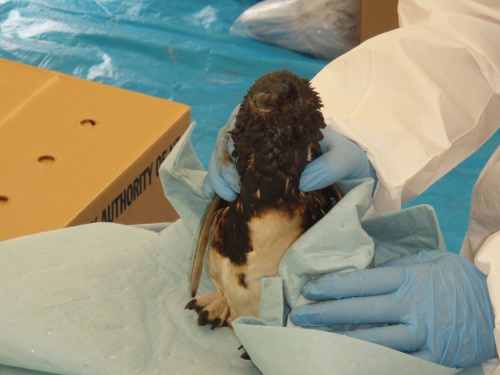
Marine mammals such as seals coming into contact with oil after surfacing may be killed outright. Oiled wildlife not killed outright can be successfully cleaned and rehabilitated but it is a long process which can take up to six weeks. The animals and birds must be cleaned thoroughly, putting them under a lot of stress which could kill them.

 
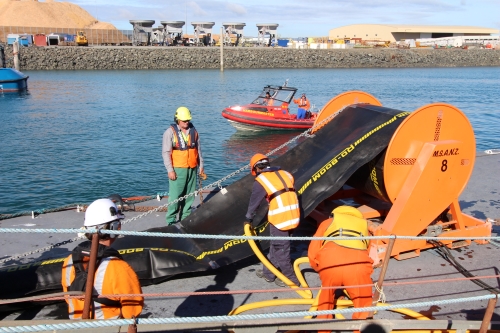
Tugs draw the floating boom out from either side of the boat during an exercise in Whangarei Harbour. The boom is used to try and contain a spill.

Oil spills will cover boats, shorelines and disable fertiliser works and refineries which use water from the ocean. A large spill could close ports for some time, stopping or restricting national and international trade. Fisheries could also be severely affected and seafood gathering would be off limits for a long time. The seafood would likely remain tainted from the exposure to hydrocarbons, which make them taste bad.

Areas like the Bay of Islands and other coastal resorts would have their tourism potential damaged.


Oil spill Equipment


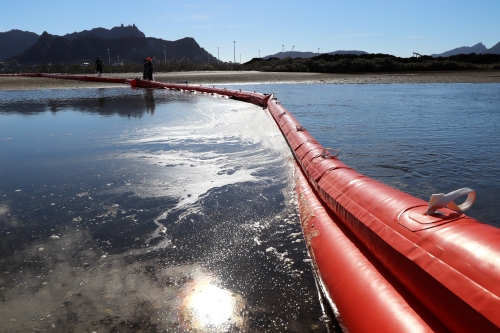
Oil booms: A boom is like a floating fence that is used to circle around an oil spill and stop it spreading or to block off an estuary, channel or bay so oil cannot pass through. It has floats on one side and chain at the bottom to hold the wide screens in place. The Ro Boom can be unravelled rapidly from big rollers on a boat and can contain an area up to about 3.6 kilometres. The boom is securely fixed to a barge and tugs begin unrolling the boom by pulling it into the sea from big orange reels. Booms tend to lose their effectiveness if there is a strong tidal flow as the oil can flow underneath. Choppy water may also make oil slop over the boom.
 
A tug prepares to roll out the boom from the big orange rollers

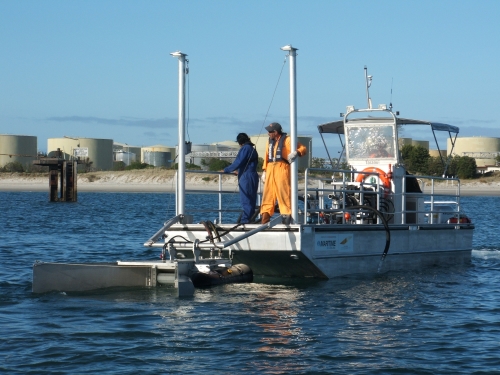
Skimmers and rope mops: This equipment is used to get the oil out of the water once the spill is contained. Equipment used in recovery of oil includes a rope mop to soak up oil and several different types of skimmers to skim the oil from the surface. Skimmers work best with calm weather.

Temporary storage equipment: Once the oil is gathered up, it has to be put in storage areas. There are several different types of equipment for this purpose. Flexible frame tanks and Flexidams are like swimming pools where the oil can be pumped. Another piece of equipment is the sea slug which can be filled with oil.

Dispersant equipment: Some types of oil can be broken down using dispersants which are sprayed over the oil. Dispersants are made up of a combination of chemicals designed to break down the oil much like dishwashing liquid. These are not suitable to be used in all conditions as the dispersants can make the oil sink to the bottom of the sea but the Council has enough chemicals to disperse about 653,000 litres of oil. All sorts of equipment is used to spray dispersants – from helicopters down to backpack sprayers. Dispersants are only used with caution because they can be harmful to the environment. Council staff have conducted tests to ensure they use the best dispersant for each type of oil which might be spilled in the region.

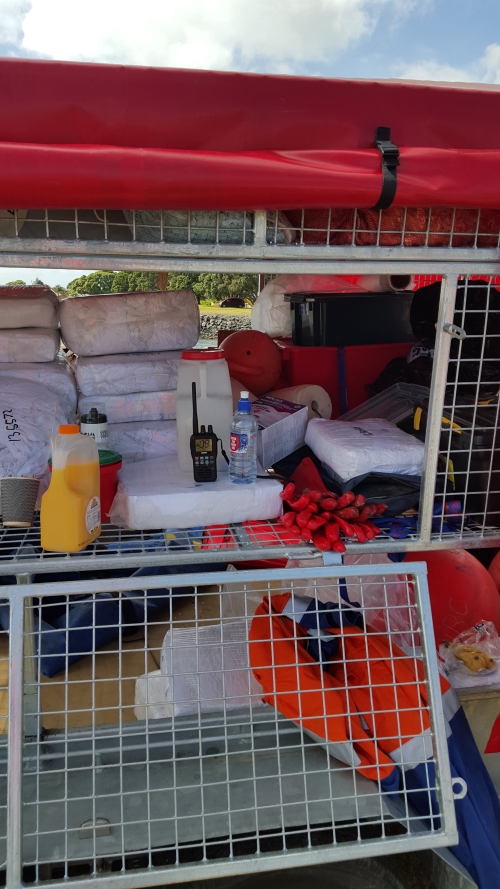
Sorbent cloth: Pads of this cloth are used to mop up residue by hand. The cloth is made of many fine layers of a material that is a byproduct of the oil industry. It is called adsorbent because rather than soaking up the residue, it traps it in the layers. This cloth is used because it only collects oil – not water. Sorbent cloth is readily available at marine chandlers.


Searching for those responsible


It is the policy of the Northland Regional Council to recover costs of the clean-up operation directly from the party responsible for the oil spill. However, the process of doing this may take some time as the evidence must be gathered, and a prosecution may involve considerable legal action and associated costs.

When there is an oil spill, investigations start immediately to try and find which ships were in the area at the time. Ships must call into ports eventually and any ships which were in the area of the spill would be checked on arrival whether their destination was another port in New Zealand or overseas. Tests might be done to see if any oil on the ship matched the contents of the spill.

Satellite has been used to track ships in some overseas spills to help gather evidence to use in court later on.

Whenever ships call into Whangarei Port, the Northland Regional Council already knows the type of oil they are carrying because the ship owners are required to notify ports. This means that if there is a spill the staff will hopefully already know what they are dealing with and how best to cope.

The ships are checked on arrival to make sure their structure and gear is up to scratch. This helps identify any possible problems.


Keeping the public informed


The Northland Regional Council has a team of communications staff which works closely with others in the oil spill emergency team. The communications staff members are responsible for keeping other staff members, the media and public informed in the event of a major oil spill. They compile media releases and distribute these via email, fax and phone. The council’s website is also updated regularly with media releases.

Communications staff have to liaise with the on-scene commander and other staff to relay correct and current information to the public and to other interested parties.

Oil spills can happen at any time or day or night. It may be in the middle of a major storm if a ship has run aground. They have to be ready to be called in at any time to help.


Specialist staff


Northland’s has a special status with having New Zealand’s only oil refinery within its region. This means the Northland Regional Council is fortunate to have specialist staff who have the knowledge and experience to deal with major oil spills.

Northland Regional Council has qualified regional on-scene commanders.  A roster operates so one of these people is on call at any time to give advice or assume command in the event of an oil spill emergency.

Many of the staff are also on the National Response Team for Maritime New Zealand, with expertise in wildlife recovery, oil spill response, community relations and media, planning, logistics, shoreline clean-up and assessment.

The maximum spill Northland is geared up to deal with is 7000 tonnes yet many tankers visiting Marsden Pt carry about 100,000 tonnes of oil. A major shipping disaster would quickly become an international scale emergency. However, most spills are less than a tonne.


Effect on birds


NRC maritime officer Peter Hudson holds an oiled bird which did not survive an oil spill at the Poor Knights Islands.
The addition of oil to the environment of sea birds is devastating. The oil clogs to their feathers causing the birds to lose their waterproofing. Thin oils are also highly toxic. The birds might swim through the film of oil without problems but then die once they go back to their nest and start preening. The effect on wildlife can continue for a long time after obvious signs of the spill have disappeared.
 

Why should you care?


How big is the problem? About 23 million litres of used oil `disappears’ into our communities and back yards every year. Oil is often put in the rubbish, down the drain, painted on fences and used in chainsaws.

Just one litre of oil can contaminate 1 million litres of drinking water. The disposal of used oil is one of New Zealand’s major environmental problems.


How can you help?


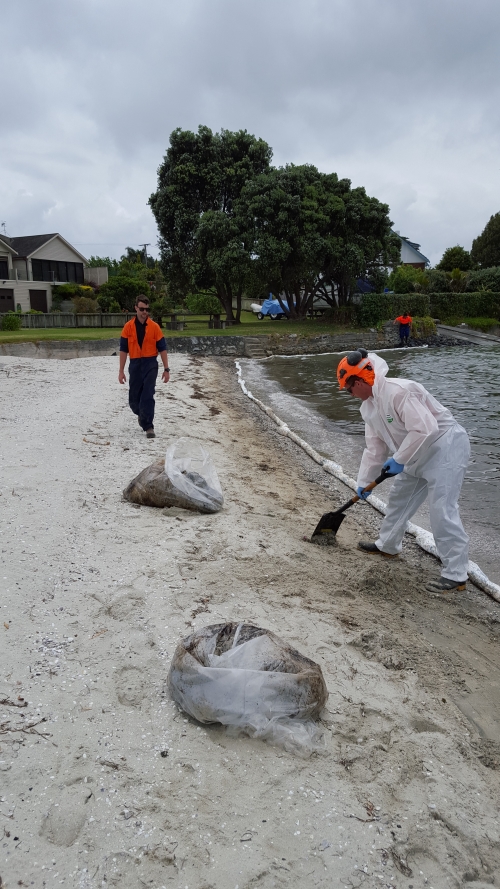
Accidents do happen. Even the smallest spill needs to be dealt with promptly so that rain cannot wash it into the stormwater system and out to a stream or beach or even into a water supply aquifer.

You can help by stopping the spill getting into a stormwater grate and cleaning it up without causing water pollution. Block off access to stormwater grates with covers, sandbags or absorbent material. Contain the spill with sand or sawdust, and sweep up solids or powders and put them in a safe container. Dispose of the waste appropriately at a landfill. If you are unsure how to deal with a spill, contact the NRC’s environmental hotline for advice.

Oil can also enter waterways through people cleaning barbecue plates into gutters and from pouring used oil into sinks and gutters.


What to do if you find an oil spill


Call the Northland Regional Council’s environmental hotline: 0800 504 639

The hotline operates 24 hours a day and seven days a week.

Do not touch the spill and be careful not to breathe any vapours as fuel is toxic. Do not touch any oiled birds or marine life without gloves as fuels and oils are bad for skin.


Classroom activity


Oil on Feathers

Each group will need:
Polystyrene trays
4 containers of motor oil
Pinocleen
Dishwashing detergent
Vinegar
Ammonia
4 feathers
Magnifying glass


1. Distribute a feather to each member of the group. Study the feather with a magnifying glass and sketch it in detail.

2. Half fill a plastic tray with water and add one tablespoon of motor oil. Watch what happens to the oil.

3. Dip your feather into the oil. Study and sketch changes.

4. In four trays fill one each with Pinocleen, ammonia, detergent or vinegar. Wash oily feathers in the liquids and rinse clean and dry carefully. Study and sketch the feather.

5. Discuss results. Which liquid cleaned the feather the best? Which did the worst job?

6. Create a list of items needed to clean birds after an oil spill.

Oil stages


Oil Uses

Sources: Northland Regional Council staff; Marine Oil Spill Contingency Plan for Northland; Maritime New Zealand; MNZ Oil Spill Contingency Plan; Britannica CD 2000.